Damaged hair can't heal itself. The hair past your scalp isn't living tissue, so a bond broken by bleach or a patch of surface worn away by heat stays that way until it's cut off. You can still change how that hair behaves in the meantime. Trim off the worst of it, condition after every wash so the rest tangles and snaps less, use protein only if a quick test says your hair wants it, and stop whatever caused the damage so the hair coming in behind it stays sound.
Signs of damaged hair
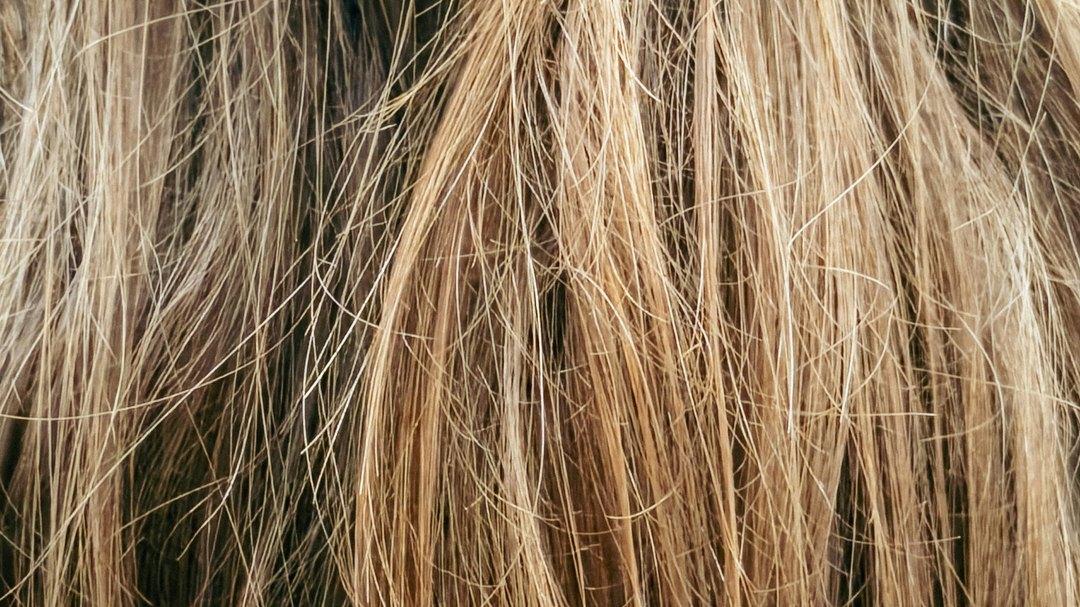
Damage is rarely even. It collects where the hair is oldest, at the ends, and wherever bleach or a hot iron has been. Those lengths feel rough between your fingers, catch on each other, and look duller than the hair near your scalp.
Other signs turn up over a week of ordinary handling. Knots show up in places that never used to knot, along with short snapped pieces in your brush, ends that fork, and frizz in the lengths that stays put whatever the weather does.
If you've been lightening the same lengths for years, the hair near your roots and the hair at your shoulders behave like two different heads of hair. They need different handling, and most of this page is about the second one.
Can you repair damaged hair?
On a label, "repair" means a coating. Conditioning ingredients carry a positive charge, and damaged hair carries more negative charge than healthy hair, so bleached and chemically treated hair picks up more of the conditioner you put on it. The coating cuts the friction between strands and lowers the force it takes to pull a comb through. You'll feel that in the first wash. It also rinses away, so it has to go back on after every shampoo.
A mask's protein pieces and amino acids settle onto and into the strand. They make it behave better without rebuilding what was broken.
Does damaged hair need protein? Try the bend test
Protein stiffens hair. Weak, overstretched hair needs that, and hair that's already stiff and brittle needs the opposite. A wet strand tells you which one you have.
Collect three or four hairs that have shed on their own, with the small white bulb still at one end, from different parts of your head and from any colored lengths. Wet them. Bend each one gently into a loop about an inch from the tip, then let go. Do the same about an inch from the bulb, where the hair is newest and has been through the least. That end is your reference point.
- Both points spring back. Your hair has enough protein and the damage is on the surface, so conditioner and a trim are the fixes. Skip the protein mask.
- The tip end stretches and stays bent, or feels limp and gummy, while the bulb end springs back. The lengths have had too much softening and not enough structure. Use a protein mask once a week and repeat the test after three or four washes. Stop when the tip end springs back.
- The hair snaps. It's already stiff or brittle, and more protein would add to the stiffness. Leave protein out for now. Use a plain conditioner and plan a trim.
One hair can mislead you, which is why you test a few. What Keratin Does for Hair covers which protein products are worth buying if your strands stretch.
Trim it, then stop the cause
Cut off the part that's worst. Damaged ends split, and splits don't close again; What Causes Split Ends shows how to find how far up yours go. If you're growing out bleach or a relaxer, you don't have to cut it all at once. An inch every six to eight weeks takes the damaged length away in stages.
Then take away the cause, or as much of it as you're willing to give up. The usual causes are bleach and permanent color, perms and relaxers, hot tools on high, and rough handling. The oxidation that dye and bleach rely on does damage that doesn't reverse. Book one chemical service at a time, and leave more time between touch-ups. Put the dryer and the iron on the lowest setting that still works, and let your hair air-dry when you can.
If you're keeping the platinum, that's a reasonable choice to make with open eyes. It means conditioner after every wash, a gentler hand with the comb, and trims more often than someone with untouched hair would need.
Questions people ask
How long does it take to fix damaged hair?
Conditioner changes how the hair feels from the first wash. The damage itself stays until it's cut off, so the full timeline depends on how much of your length is damaged and how much you'll cut at once.
Should you cut off damaged hair?
The worst of it, yes. Ends that are split or snapping keep catching on the hair around them. If the damage runs halfway up, cutting it in stages over several months works, as long as you keep conditioning what's left.
Sources
- Dermatology Times. Chemically damaged hair: No easy answers. 2005.
- He Y, Cao Y, Nie B, Wang J. Mechanisms of impairment in hair and scalp induced by hair dyeing and perming and potential interventions. Frontiers in Medicine, 2023.
- Gavazzoni Dias MFR. Hair cosmetics: an overview. International Journal of Trichology, 2015.
- American Academy of Dermatology. How to stop damaging your hair.