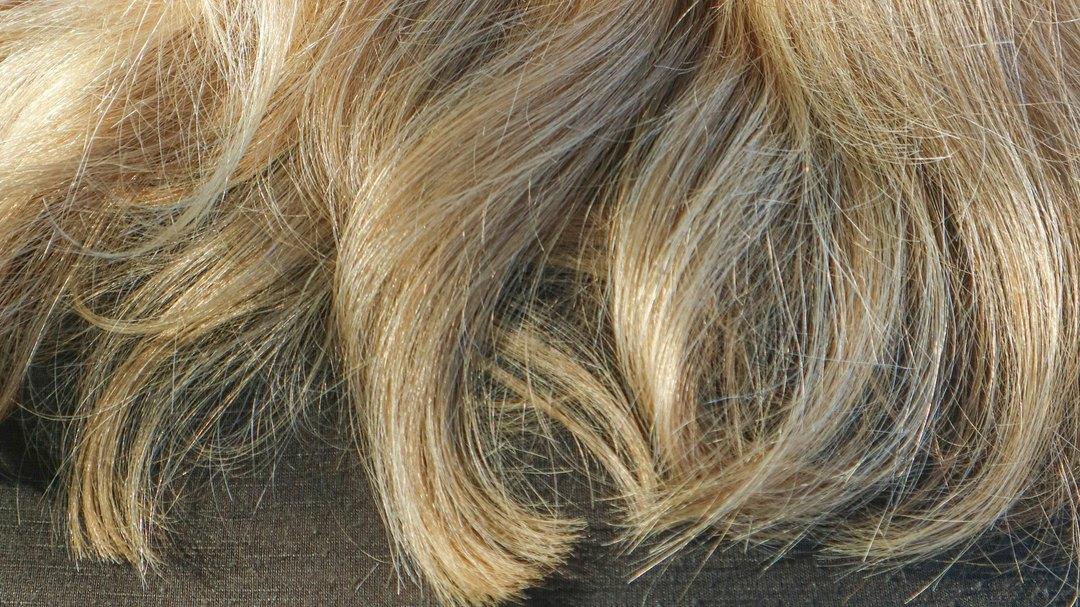
Split ends are wear that has run its course. The tip of each hair is its oldest part, and it has been through every wash, brushing and blow-dry since it grew out of your scalp. Each of those rubs away a little of the thin outer layer that holds the strand together, and once that layer is gone at the tip, combing and twisting pry the fibers inside apart lengthwise until one end becomes two or more.
How do split ends happen?
Two kinds of force do it. Friction wears the surface whenever strands rub against each other or against fabric. Twisting and bending do the splitting, and they're at their strongest when a comb drags through a tangle. A knot near the ends pins a few hairs in place while the comb keeps pulling, and the strain runs down those strands to tips that have already lost their protection.
Wear builds from root to tip over the years a strand spends growing, so the ends are always the furthest along. Hair that's been bleached, straightened or blow-dried a lot splits more readily, and bleached hair gives way after fewer rounds of bending than untreated hair.
A split can be a clean fork or a tip that frays into several thin strands. Either way, it doesn't close back up.
What makes split ends worse
Most of what speeds splitting comes back to friction and to pulling through knots. Brushing from the roots down pushes tangles toward the ends, where the hair is weakest. A towel rubbed over wet hair roughs up the surface while it's soft. Without conditioner, strands rub directly against each other. Conditioner lowers that friction, which is why a comb glides through conditioned hair where it used to catch.
Length plays a part too. Long hair has older ends than short hair, so it shows more splits on the same routine.
If you've been putting off trims to keep your length, you've likely watched the dry, see-through section at the bottom get a little longer each month. Those ends aren't coming back, and the length they add is thin and frayed.
Do split end treatments work?
For a while. Protein in a conditioner is drawn to the hair's own keratin and holds the split halves together until your next shampoo. Some products pair two polymers that bind the split more firmly, enough to hold through combing, but even those rinse off when you wash. No product mends a split end permanently.
That makes them useful for an event or a photo, when you want the ends to look neat for an evening. Using one every wash keeps the ends looking smoother, and the splits are still there under it each time it rinses off. If your hair is fine and a sealing serum leaves the ends limp and stringy, skip it.
How much to trim off split ends
Sit by a window in daylight. Take a small section from the back of your head, where you don't usually look, and twist it into a loose rope. Run two fingers slowly up the twist. The ends that poke out along the rope belong to hairs shorter than their neighbors, and not all of them have split. Pull a few loose and hold them against something that contrasts with your hair color. A forked or frayed tip is a split. Note how far up from the bottom the highest one sits, then check a section from the front.
- All the splits sit in the bottom half inch. Trim half an inch, and check again in a couple of months.
- They run one to two inches up. Cut to a little above the highest one you found. If that's more length than you'll part with at once, cut half of it now and the rest in six weeks, and keep conditioning the ends in between.
- You can't find a single fork. Your ends may feel rough without splitting. A trim won't change much, and How to Fix Damaged Hair covers what will.
When you book the cut, tell whoever does it how far up the splits go. "Just a trim" means different lengths to different people.
Questions people ask
Can you get rid of split ends without cutting?
No. Sealing products hold them together until the next wash, and gentle handling means fewer new ones form. Cutting is the only thing that takes away the splits you already have.
Why do I have so many split ends?
Look for something that changed. A new hot tool or a higher setting, recent bleach, a brush that tugs, or a longer gap than usual since your last trim are the common ones. If nothing changed, look at how you detangle. Pulling a comb down through knots puts the most strain on the ends, and How to Stop Hair Breakage has a gentler way to do it.
Sources
- Gavazzoni Dias MFR. Hair cosmetics: an overview. International Journal of Trichology, 2015.
- D'Souza P, Rathi SK. Shampoo and conditioners: What a dermatologist should know?. Indian Journal of Dermatology, 2015.
- Rigoletto R, Zhou Y, Foltis L. Semi-permanent split end mending with a polyelectrolyte complex. Journal of Cosmetic Science, 2007.
- Taylor D, Barton E, Duffy I, et al. The biomechanics of splitting hairs. Interface Focus, 2024.