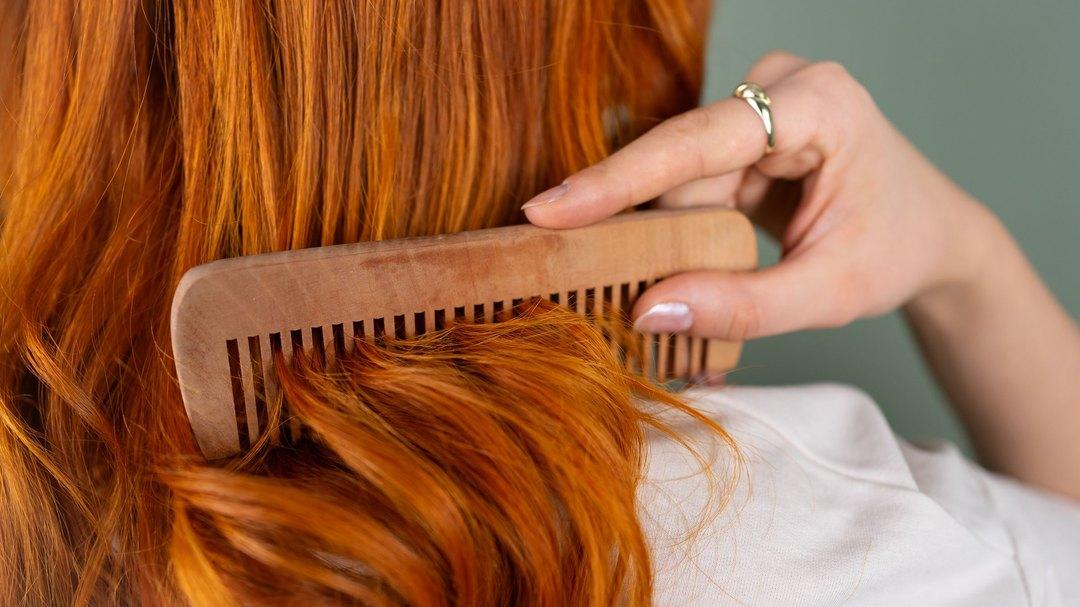
If your hair crackles when you pull off a hat and rises to meet the brush before the bristles reach it, it's carrying a static charge. To get rid of it now, rub a drop of leave-in conditioner between damp palms and press them flat over the flyaways. To keep it from coming back, put moisture into the air and conditioner on your hair, since charge builds up and stays put when the air is dry and the surface of each strand is bare.
Why your hair gets static
Rubbing moves electric charge. When your hair drags against a knit hat, a sweater collar, a pillowcase or the bristles of a brush, a little charge jumps onto the strands. Every strand gets the same kind of charge, and like charges push each other away, so the hairs spread into a halo and drift toward anything close by, your cheek included.
Humid air drains that charge off quickly, because a trace of water on each strand gives it somewhere to go. In dry air, hair behaves like any other insulator, and the charge can sit on it for a long time. Cold winter air holds little water, and indoor heating dries it further.
All of this happens on the surface of the strand, so the fixes go on the surface too.
It's often worst on the day you wash. Freshly shampooed hair has a bare surface with a slight negative charge, and conditioner cancels it out, because its working ingredients carry a positive charge and cling to the strand. If you've been skipping conditioner in winter because it leaves your hair limp, the flyaways may be the price. Fine hair shows it first, because a light strand lifts with less charge.
How to get static out of hair right now
Water works fastest. Run your hands under the tap, shake them until they're damp rather than dripping, and press your palms over the flyaways from the crown down, without rubbing, since rubbing charges the hair again. The film of water lets the charge drain away within seconds, and the fix lasts until it dries off.
A drop of conditioner lasts longer. Rub a small amount of leave-in between your palms until it's thin, or a little hand lotion if that's what's in your bag, and smooth it over the outside of your hair. Conditioner cancels the charge already there, and both leave a slick layer, so less new charge builds up the next time a scarf rubs against you. On fine hair, use half as much.
Leave the brush alone until either fix has settled. Every stroke through dry, charged hair adds more.
The palm test: find what's charging your hair
Hold your flat hand an inch or two above your hair, without touching it, and watch. Charged strands rise toward your palm and waver there. Hair without a charge stays where it is.
Use it at the moments static usually shows up, such as when a hat comes off or after you brush, and let the result decide what to change.
- The strands jump after a hat or a sweater. Smooth a little leave-in over your hair before you put them on, so the surface is already coated when the fabric rubs across it.
- They jump after brushing. Brush less once your hair is dry, and if one brush makes it worse every time, switch to a comb or brush made of something else, because the material changes how much charge rubs onto hair.
- They're lifting all day, whatever you've done. The air in your home is too dry, and the routine changes below will do more than any quick fix.
Test again after each change. When your palm passes over without pulling anything up, the change worked.
How to stop static hair in winter
Condition after every wash, from the middle of the length to the ends, and on cold days add a light leave-in once you've pressed the water out. On fine hair, a spray leave-in on the lengths coats them without flattening the roots.
Run a humidifier in your bedroom, where you spend the longest stretch of the day. The moisture it adds to winter air lets charge drain off your hair, and off your clothes and blankets too. Empty and refill the tank daily and scrub it every third day, because standing water grows microbes, and use distilled water if you can, since tap water can leave a fine white mineral dust on the furniture. If the windows start to fog, turn it down.
If static only shows up for a couple of weeks in the coldest stretch, you don't need a new routine. Damp palms on the way out the door are enough.
Questions people ask
Why is my hair so static?
Dry indoor air is usually behind it, together with something rubbing against your hair while its surface is bare. The most common moment is right after a shampoo with little or no conditioner. Fix the surface first with conditioner and a leave-in, then the air.
Is static a sign of damaged hair?
Static by itself tells you about the air and the surface of your hair. Bleached and dyed hair picks up close to the same charge as hair that's never been treated, so flyaways alone don't mean damage. Judge that by how your ends feel and whether they snap.
Sources
- Jachowicz J, Wis-Surel G, Garcia ML. Relationship between triboelectric charging and surface modifications of human hair. Journal of the Society of Cosmetic Chemists, 1985.
- Gavazzoni Dias MFR. Hair cosmetics: an overview. International Journal of Trichology, 2015.
- U.S. Environmental Protection Agency. Use and care of home humidifiers.