If your hair has never been bleached, relaxed or permed, you can probably skip bond repair treatments. The bonds are sulfur links that tie the protein chains inside each strand together, and they're a large part of what keeps wet hair from snapping. Chemical services break them, and a bond repair treatment is meant to help that hair hold together. You can check whether yours is doing that at home, in about a month.
What are bonds in hair?
Hair is mostly keratin, a protein built from long chains that lie side by side. At intervals along their length, neighboring chains are tied to each other by disulfide bonds, each one a link between two sulfur atoms.
Bleach breaks these rungs as a side effect of lightening. They're the main place it attacks the protein, and hair gets weaker when it's wet almost in step with the bonds it loses. Relaxers and perms break and rearrange them on purpose, so the hair holds a straighter or curlier shape.
The breakage stays in the lengths that were treated. New growth comes in with its bonds intact, so bleached hair is firm near the roots and weaker toward the ends, and the ends are where wet hair gives way under the comb. If you've been finding short pieces on the bathroom floor after combing out wet hair, those are the weak lengths snapping.
What a bond repair treatment does
Bond repair products are built around ingredients designed to bridge broken links. Some are mixed into the bleach at the salon, and others are treatments you use at home and rinse out, before or after shampoo.
The evidence is thinner than the labels. When bleached hair treated with commercial products of this type was examined closely, the number of sulfur links inside the strand hadn't gone up. Some of the existing links had shifted, and under the microscope the surface of the hair looked smoother and more orderly than bleached hair left untreated. A smoother surface is worth having, though it's a separate result from rebuilt bonds.
So read "rebuilds bonds" as what the product is designed to do, and judge it by what your hair does.
Who benefits, and who won't notice a difference
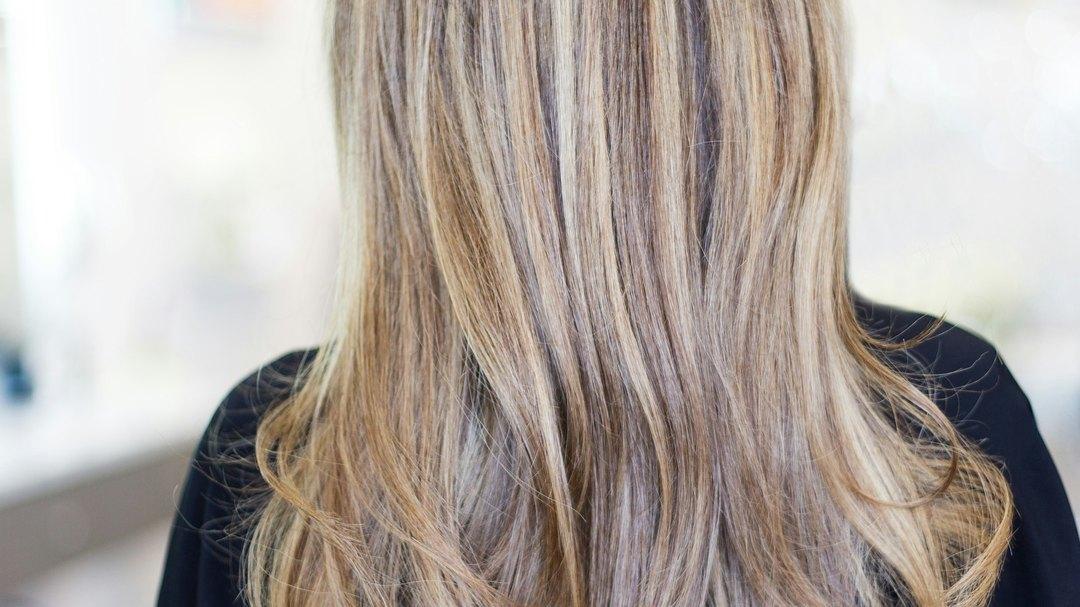
The people with the most to gain have hair that's been bleached, especially more than once or all the way to pale blonde, and hair that's been relaxed or permed. Long hair that has carried years of color and highlights at the ends belongs here too.
If your hair has only ever met shampoo and the odd blow-dry, there are few broken links for anything to bridge, and what you'll feel is the conditioning. A good regular conditioner will feel much the same and cost less.
A bond treatment works on hair that has already grown. It does nothing for shedding or for how much hair grows, and shedding more than usual is a question for a doctor.
How to tell whether a bond repair treatment is working
Before your first treatment, take a baseline count. On a normal wash day, detangle the way you always do, with the same comb or brush, sitting over a dark towel, or a light one if your hair is dark. Collect every hair that comes out.
Then sort them. A shed hair is full length or close to it, with a tiny pale bulb at one end; it finished its growing cycle and fell out, and no hair product changes that. A broken piece is shorter, has no bulb, and ends blunt or frayed. Count only the broken pieces and write the number down. Do it on two wash days if you can, because one bad tangle can throw a single count off.
Use the treatment as the label says for four weeks. Then repeat the count on a wash day, with the same comb and the same towel.
Fewer broken pieces means it's helping, so keep going. About the same means you're paying extra for a conditioner. If the number went up, look at how you detangle before you blame the bottle, and How to Brush Your Hair covers the wet-detangling order.
Questions people ask
How often should you use a bond repair treatment?
As often as the label says, since formulas differ. Give it the full four weeks before you judge it. If the count drops, try spacing the treatments out and count again to see whether the number holds.
Can a bond repair treatment undo bleach damage?
Not completely. Bleached lengths stay weaker than new growth, and the worst of the damage leaves with a trim. At best, a treatment helps the hair you have hold up better while it grows out.
Sources
- Robbins C. Chemical aspects of bleaching human hair. Journal of the Society of Cosmetic Chemists, 1971.
- Di Foggia M, Boga C, Micheletti G, Nocentini B, Taddei P. Structural investigation on damaged hair keratin treated with α,β-unsaturated Michael acceptors used as repairing agents. International Journal of Biological Macromolecules, 2021.
- Gavazzoni Dias MFR. Hair cosmetics: an overview. International Journal of Trichology, 2015.