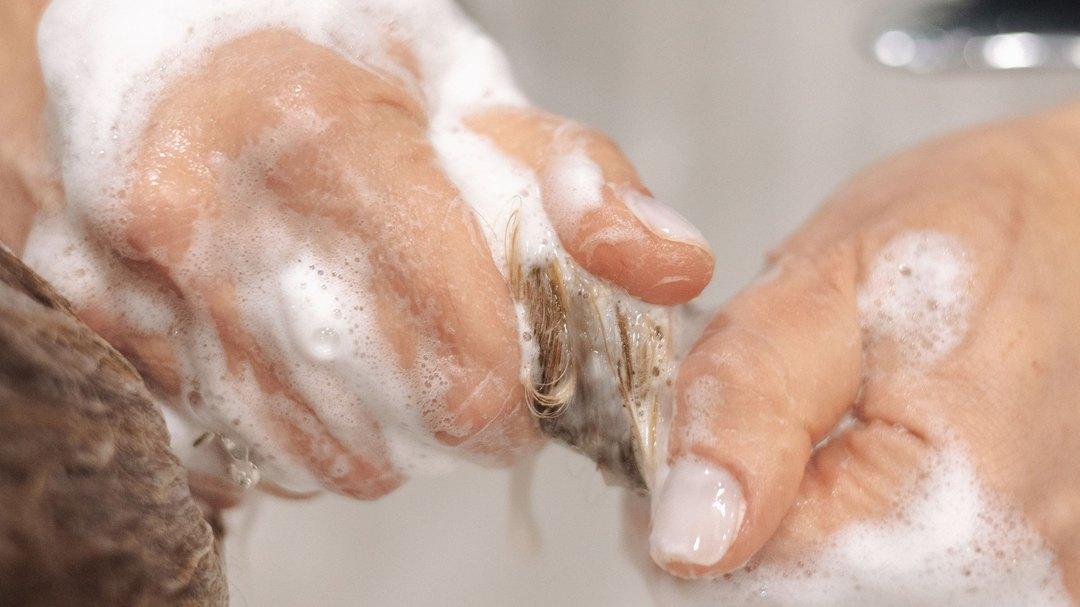
For some hair, in small doses, yes. A weak apple cider vinegar rinse after shampoo can leave the lengths smoother and shinier, with less static, and it's worth trying if you live with hard water. It won't stand in for conditioner, and vinegar on skin has caused burns. Mix it weak and start with once a week. Leave it out whenever your scalp is irritated.
What apple cider vinegar does for your hair
Vinegar is an acid. Store-bought apple vinegar tests at roughly pH 2.5, while the surface of a hair sits near pH 3.7 and the scalp around 5.5. Plenty of shampoos are less acidic than either of those, and in one survey of 123 shampoos, more than half came in above 5.5.
The more alkaline the product, the more negative charge it leaves on the hair's surface. Charged strands rub against each other harder and push apart, so hair frizzes and flies. A dilute acid after shampoo brings that charge back down. The surface lies flatter, the strands slide past each other, and smoother hair reflects more light, which is the shine people notice after a vinegar rinse.
A conditioner with a low pH does the same job after shampoo. If you already condition after every wash, the rinse has less left to fix, and you may see no difference at all.
Apple cider vinegar and hard water
Hard water carries dissolved calcium and magnesium. Hair washed in it every other day for a month picked up more of both than hair washed in distilled water, and under a microscope its surface looked ruffled. If your hair started feeling dull and coated after a move, hard water is a suspect, and When Your Routine Stops Working covers the others. A vinegar rinse is a cheap experiment to run against it, and the three-rinse check below tells you whether it's doing anything.
It won't put water back into the hair either. Rough hair reads as dry to your fingers, so a smoother surface can feel like moisture when the water inside hasn't changed; What Water Actually Does explains that mix-up.
How to use apple cider vinegar on your hair
- Shampoo and rinse as usual.
- Stir one tablespoon of apple cider vinegar into a cup of cool water. Stay at that strength for a few weeks before you try two tablespoons.
- With your head back, pour it slowly over your lengths, keeping it out of your eyes.
- Leave it for a minute, then rinse it out with plain water.
- Condition the ends if they still need it.
Once a week is enough to see whether it does anything for you. Judge it after three rinses, on dry hair in daylight. Smoother, shinier lengths mean it's worth keeping. No change means your conditioner already covers it, and you can save the vinegar for salad.
Pay attention to your scalp while the rinse is on. If it stings, or the skin looks pink afterward, rinse with plenty of plain water and stop.
When to skip an apple cider vinegar rinse
Leave it out if your scalp is irritated, scratched, sunburned or flaking. Vinegar used on skin as a home remedy has caused chemical burns, and there's no reason to try your luck on skin that's already sore.
Skip it in the week after a color, bleach, perm or relaxer. Your scalp has had enough chemistry for one week, and if something starts to sting, you'll want to know which product to blame.
Questions people ask
Can you leave apple cider vinegar in your hair?
No. Rinse it out with plain water after a minute or two, so the acid isn't sitting on your scalp for hours.
Does an apple cider vinegar rinse help dandruff?
Flaking that keeps coming back is a scalp problem, and a kitchen rinse isn't a treatment for it. See a doctor about the flakes, and keep the vinegar for your lengths once your scalp is calm.
Sources
- Dias MFR, Almeida AM, Cecato PMR, Adriano AR, Pichler J. The shampoo pH can affect the hair: myth or reality?. International Journal of Trichology, 2014.
- Arvaniti OS, Mitsonis P, Siorokos I, Dermishaj E, Samaras Y. The physicochemical properties and antioxidant capacities of commercial and homemade Greek vinegars. Acta Scientiarum Polonorum Technologia Alimentaria, 2019.
- Srinivasan G, Chakravarthy Rangachari S. Scanning electron microscopy of hair treated in hard water. International Journal of Dermatology, 2016.
- Feldstein S, Afshar M, Krakowski AC. Chemical burn from vinegar following an internet-based protocol for self-removal of nevi. Journal of Clinical and Aesthetic Dermatology, 2015.