A good shampoo for oily hair cleans hard and leaves almost nothing on the hair. On the ingredient list, that usually means a lauryl sulfate in the second or third line and no silicone or oil near the top. Use it twice on your scalp and keep conditioner well below your roots.
What shampoo is good for oily hair
The front of the bottle sorts shampoos by mood, and words like balancing or purifying mostly tell you which shelf it was meant for. Turn it over. Ingredients are listed from most to least, apart from the ones present in tiny amounts at the end, so the first five or six lines describe most of what you're paying for.
Look for three things there:
- The main cleanser. Water comes first. A shampoo built to clean thoroughly usually lists a lauryl sulfate next, such as sodium lauryl sulfate or ammonium lauryl sulfate. They're the usual cleansers in shampoos for oily hair.
- A second strong cleanser. Ingredients ending in sulfosuccinate are common partners in oily-hair formulas, because they're good at taking oil off the scalp.
- What isn't there. Dimethicone or another silicone in the first lines, oils high on the list, or 2-in-1 on the front all mean the shampoo leaves a coating on purpose. A 2-in-1 washes away dirt and oil and leaves silicone behind as a thin film. That helps dry hair. On an oily scalp it adds a layer on top of the oil you're trying to remove.
Sodium laureth sulfate, easy to mistake for the lauryl kind, is the cleanser you'll find on most bottles for normal to dry hair. It takes oil off more mildly. If your roots are greasy again by evening and your shampoo leads with a laureth sulfate, that's the first thing to change.
A bottle that passes all three checks was made for a scalp like yours. One that fails the last check was made for someone with drier hair, whatever the front says.
Does more lather mean cleaner hair
Lather spreads shampoo across your scalp and down the hair. It does none of the cleaning itself, and the amount of foam says nothing about how much oil comes off. Brands add foaming agents because people expect suds, so a thin, unexciting lather from a well-built shampoo is no reason to switch.
How to wash oily hair
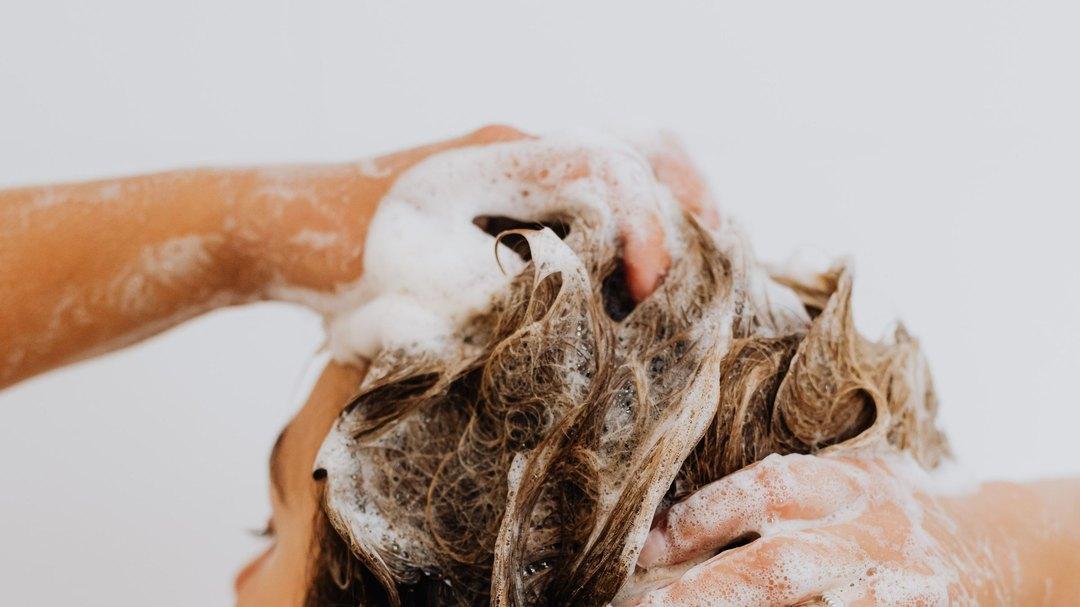
Wet your hair until the water has reached the scalp, then put shampoo on the scalp itself, a little at a time, parting your hair with your fingers as you go. Work it in with your fingertips for about a minute and rinse. Then do it all again. The first round loosens the oil and the second lifts it away.
Leave the lengths out of it. The rinse water carries enough shampoo down them, and the strong cleansers that suit an oily scalp are hard on the hair below it. There's more on the scalp-first wash in what shampoo is for.
Keep conditioner off your roots
Most people put conditioner on the way they put on shampoo, from the top down, and then wonder why the roots look slick by the afternoon. On straight hair with an oily scalp, conditioner belongs on the ends. Squeeze the water out first. Then work it through the last few inches and stop around ear level. The same line applies to leave-ins and hair oils, since leave-on products can make straight hair look oily and dull.
Curly and wavy hair often pairs an oily scalp with dry lengths, and that changes the rule. If that's your hair, condition the full length and keep the strong shampoo for the scalp alone. The curly hair routine goes through the rest.
Questions people ask
Is it okay to wash oily hair every day?
Yes. Daily shampooing isn't necessary for everyone, and an oily scalp is the case where it is. If your hair is straight and your roots are greasy by the next morning, a daily wash is reasonable.
Do you need a clarifying shampoo for oily hair?
Only if you use a lot of styling product. Clarifying shampoos are built to strip the buildup from hairspray and gel, usually about once a week, and they clean with the same lauryl sulfates as a shampoo for oily hair. If your everyday shampoo already passes the label check, it's doing similar work every wash.
Why is my hair greasy the day after I wash it?
Check your roots for something you put there. Conditioner or a leave-in applied too high, or a 2-in-1 shampoo, are the first things to rule out. If none of those fit, your scalp probably makes a lot of oil, and a daily wash with a strong shampoo is the practical answer.
Sources
- Draelos ZD. Essentials of hair care often neglected: hair cleansing. International Journal of Trichology, 2010.
- Gavazzoni Dias MFR. Hair cosmetics: an overview. International Journal of Trichology, 2015.
- American Academy of Dermatology. Tips for healthy hair.
- U.S. Food and Drug Administration. Cosmetics labeling guide.