There's no good evidence that rosemary oil does anything special for your hair. Most of the claims trace back to one small trial in people with pattern hair loss, and that isn't enough to recommend it for growth. What you can count on is a strong herbal smell and some risk of irritation, because rosemary essential oil is concentrated. If you enjoy using it, dilute it, test it on your arm first, and keep it off sore or broken skin.
What the rosemary oil study tested
The trial people cite split 100 adults with pattern hair loss into two groups for six months. Half used rosemary oil, and half used the lower-strength form of minoxidil, a hair-loss drug. Nobody got a plain oil or nothing at all, so the study can't show what would have happened without either one. It's a single trial in one kind of hair loss, and it says nothing about a scalp that isn't thinning.
Scalp itching became more common over those six months in both groups.
If you've been rubbing it into your part every night since a video promised a thicker ponytail, and your scalp has started to itch, the itch is the part to take seriously. Shedding more than usual, or a part that looks wider than it used to, is a reason to see a doctor.
How to dilute rosemary oil
Check what you bought. A dropper bottle of rosemary essential oil is the concentrated form and has to be diluted before it touches skin. A ready-to-use hair oil with a carrier oil like jojoba on the label is already diluted, so follow its directions.
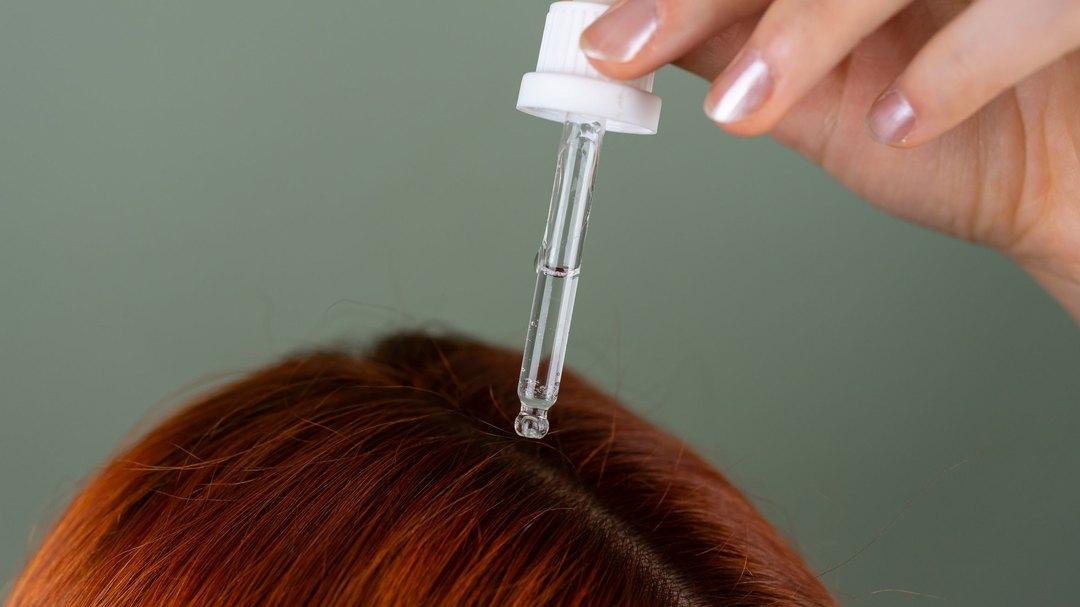
Pure essential oils are potent, and mixing them into a carrier oil is the best way to avoid a bad reaction. For a scalp oil, stir two or three drops of rosemary essential oil into a tablespoon of a plain oil like jojoba or sunflower. That's a mild mix that still smells clearly of rosemary, and more drops only make irritation likelier.
Keep the bottle where children can't get at it, since they can be more vulnerable to essential oils than adults.
How to patch-test rosemary oil
Test the diluted mix, since that's what your scalp will meet.
- Pick a spot about the size of a quarter on the underside of your arm or the bend of your elbow, where it won't get rubbed off.
- Put on a little, leave it as long as you'd leave it on your head, then wash it off.
- Repeat twice a day for seven to 10 days.
- Watch for red, itchy or swollen skin.
If your skin reacts, wash the spot gently and don't use the mix again. A cool compress or petroleum jelly can calm it, and if that doesn't help, see a doctor.
A rosemary allergy is uncommon, though it may go unrecognized, because a rash is easy to blame on something else. A few people who react to thyme react to rosemary too, so if thyme has given you a rash, skip rosemary.
How to use rosemary oil before a wash without greasy roots
Start with dry hair, brushed through, and part it into four sections. Dip your fingertips in the mix and press it along each part, onto the skin rather than the lengths. A teaspoon of mix covers the whole scalp. Work it in gently with the pads of your fingers and leave it for 30 minutes to an hour.
Then shampoo twice, with the lather on your scalp both times. The first round loosens the oil and the second lifts it, as What Shampoo Is For explains. Condition only your lengths.
Look at your roots in daylight once your hair is dry, and again the next morning.
- The roots look clean and move when you shake your head. Keep the amount.
- The part looks flat or slick. Use half as much next time, or add a third round of shampoo.
Start with once a week. Dry ends can take a little of the plain carrier oil, and Coconut Oil for Hair covers oiling the lengths before a wash.
When to leave rosemary oil out
Keep it off any skin that's broken or irritated. If your scalp already itches or flakes, see a doctor before you put any oil on it.
Keep the mix behind your hairline and wash your hands afterward, so none ends up in your eyes. If some gets in your eye, rinse it with lukewarm water and call Poison Control. If a rash shows up on your scalp or neck after a session, stop using the oil and wash the area gently.
Questions people ask
What does rosemary do for hair?
It makes your hair smell of rosemary, and nothing else it does on hair has good support. On the lengths, the carrier oil does the softening, so if you don't care for the smell, you can leave the rosemary out and use the plain oil.
Is rosemary good for hair in a shampoo or rinse?
It mostly adds scent. The evidence for anything more is no better than for the oil, and the allergy risk comes along, since rosemary extracts as well as the raw plant have caused reactions. Patch-test a new rosemary shampoo the way you would any other product.
Sources
- Panahi Y, Taghizadeh M, Marzony ET, Sahebkar A. Rosemary oil vs minoxidil 2% for the treatment of androgenetic alopecia: a randomized comparative trial. Skinmed, 2015.
- Miroddi M, Calapai G, Isola S, Minciullo PL, Gangemi S. Rosmarinus officinalis L. as cause of contact dermatitis. Allergologia et Immunopathologia, 2014.
- Poison Control, National Capital Poison Center. Essential oils: Poisonous when misused.
- American Academy of Dermatology. How to test skin care products.