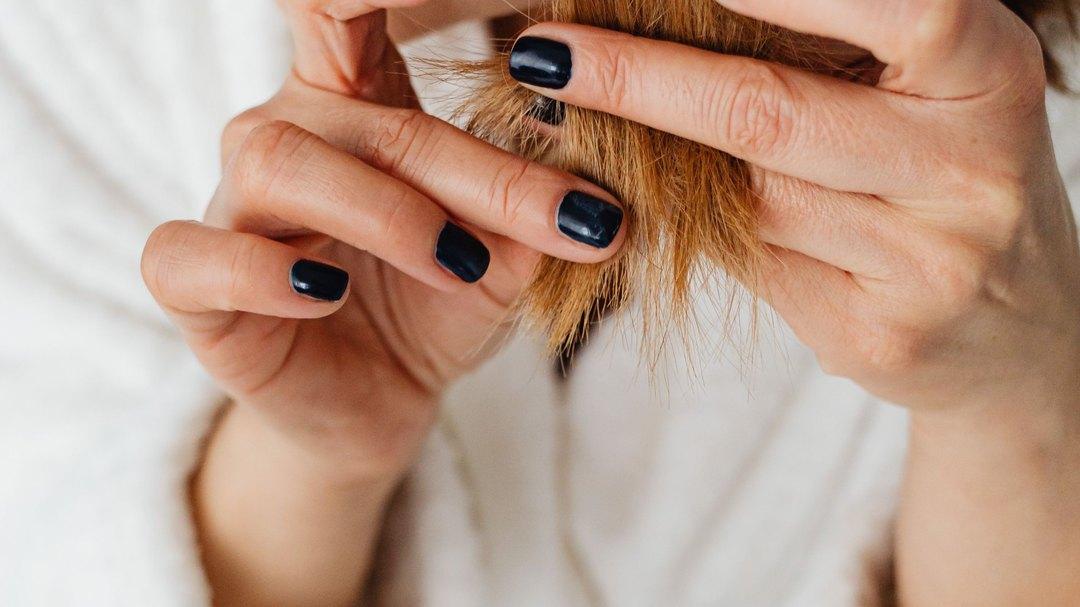
Most people put on too much hair oil, and put it on too early. Use a few drops on the mid-lengths and ends as the last step after your leave-in and styler, on damp hair after a wash or on dry hair between washes. As a treatment, it can also go on dry lengths for up to an hour before you shampoo. Keep it off your scalp, and don't count it as heat protection.
Should you put oil in wet or dry hair?
Damp hair spreads oil further, so the same drops cover more strands in a thinner layer. A film of oil on the strand slows how fast water moves in and out of the hair. Some water still gets through, and the effect lasts only as long as the film does, but oil put on damp hair slows the loss of the water still inside the strand while it dries.
On dry hair, oil shows faster. Use half what you'd use on damp hair and smooth it over the outside of the ends, where flyaways stick up. If you've been working oil into dry hair until it finally lies flat, and it's stringy by lunch, start the next day with a single drop.
Oil makes neighboring strands cling to each other, so over-oiled ends hang together in stringy clumps. With plant oils such as coconut, olive and sunflower, that cling eased over time as some of the oil soaked in and the film on the surface thinned. With mineral oil it stayed. Judge a plant oil an hour after it goes on rather than in the first minute.
Do you put hair oil on before or after washing?
Before a wash, oil works as a treatment. Brush your hair, spread a small amount from the middle of the length to the ends, leave it for 20 minutes to an hour, then shampoo. Some oils get into the strand and cut how much water it takes up in the shower, so it swells less, and repeated swelling and drying is one of the things that wears hair down. How to Use Coconut Oil for Hair has the full pre-wash method.
After a wash, it's a finish. A drop or two on damp ends, or a smaller amount on dry ones, keeps the lengths smoother until the next shampoo. If your hair is fine and goes flat under any oil left in, use oil only before washing, and let the shampoo take the weight off.
Keep oil off your scalp either way. Oiling the scalp can leave some people more prone to a flaky, itchy rash, and if your scalp already flakes or itches, see a doctor before you put anything on it.
How much hair oil to use
Count drops, rub them between your palms until they look glossy with nothing pooling in the creases of your fingers, then press them in from the ends upward.
- Fine or straight hair. One drop, on the ends only. Leave-on products can make straight hair that's never been colored look oily and dull.
- Medium or wavy hair. Two or three drops, over the bottom few inches.
- Thick or curly hair. Three to five drops, from mid-length down, one section at a time.
- Coily or tightly curled hair. More than that, worked through section by section. Dry, tightly curled hair is the type oiling suits best, and fine, straight hair the type it most often weighs down.
Add a drop at a time on the next wash day if the ends still feel rough. If your palms are wet with oil, wipe one on a towel before you touch your hair.
Where oil goes with a leave-in and a styler
Water-based products go on first, and oil goes on top. A leave-in or a gel spreads poorly over a strand that's already coated in oil, so oil laid down first keeps them from reaching the hair evenly. On a gel day, let the gel dry into its stiff layer, then rub a drop of oil between your palms and scrunch the stiffness out.
Coily or very dry hair is the exception. If your ends feel dry an hour after styling, try the oil between the leave-in and the cream, with the cream on top.
Should you use oil before heat?
Use heat protectant before heat and save the oil for after. A dryer or a flat iron calls for a protectant built on silicones, and a plain oil isn't a stand-in for one. Heat Protectant covers how to put it on. Once you've finished styling and your hair has cooled, smooth a drop of oil over the ends.
Questions people ask
Is hair oil good for your hair?
On the lengths, yes. Oiled hair slides past itself with less friction, and regular oiling helps it resist breaking. If your hair is short, healthy and never feels rough, you can skip oil altogether, and nothing in your routine will miss it.
Is hair serum the same as hair oil?
Sometimes it's the same thing under another name. Some bottles sold as hair oil are mostly silicone with a little plant oil added, so check the first few ingredients for names ending in -cone. Dimethicone, the most common silicone in hair care, coats the strand and protects it from rubbing. Use either kind the same way, a few drops, last.
Sources
- Gavazzoni Dias MFR. Hair cosmetics: an overview. International Journal of Trichology, 2015.
- Keis K, Huemmer CL, Kamath YK. Effect of oil films on moisture vapor absorption on human hair. Journal of Cosmetic Science, 2007.
- Keis K, Persaud D, Kamath YK, Rele AS. Investigation of penetration abilities of various oils into human hair fibers. Journal of Cosmetic Science, 2005.
- Cleveland Clinic. Hair Oiling: Should You Try It?, 2022.