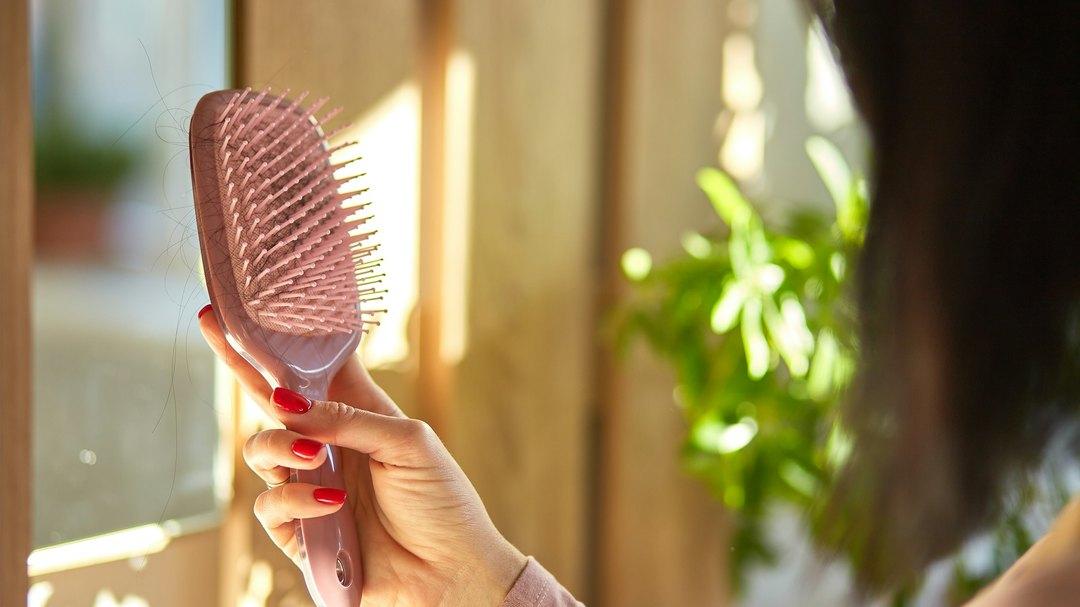
The gray fuzz packed down at the base of the bristles is shed hair and lint, held together by scalp oil and old product. To clean a hairbrush, pull that out first, then wash the bristles in warm water with a little shampoo, rinse them, and leave the brush to dry bristles down. A plastic brush can take the whole routine as written. Cushion, boar bristle, and wooden brushes each need one change to it, and skipping that change is how a good brush ends up warped or musty.
How to clean a hairbrush, step by step
If you've been rinsing your brush under the tap and calling it clean, the fuzz at the base is still there. The comb step below is what lifts it. This is the base method, and the sections after it say what to change for each kind of brush.
- Pull the hair out. Fingers take the loose top layer. For the matted layer at the base, run the tail of a comb along each row of bristles and lift it up and out. If hair has wound itself tight around the pins, snip across it with small scissors and the pieces pull free.
- Wash. Swish the bristles through a bowl of warm water with a squeeze of shampoo, then scrub between them with an old toothbrush, paying most attention to the base, where the fuzz sits.
- Rinse under running water until no suds are left.
- Dry it bristles down. Shake out what water you can, then lay the brush face down on a towel and leave it until it's dry all the way through.
Paddle brushes with a cushion
The rubber cushion on a paddle brush is hollow, with a small air hole, and water that gets in through the hole is slow to find its way back out. Mold needs moisture to grow. Damp things that dry within a day or two usually don't grow it, and a cushion that stays wet inside for longer is where it gets its chance.
So keep the cushion out of the bowl. Hold the brush face down and dip only the pins, then do the scrubbing and rinsing with it still pointing down. Dry it face down so anything that did get inside can run back out of the hole.
Before you put it away, press the middle of the cushion with your thumb. If it squelches, or a drop of water appears at the air hole, it isn't dry yet. Leave it face down for another few hours and press again.
Boar bristle brushes
Boar bristle is hair, so the shampoo you use on your own hair is the right cleaner for it. The bristles sit close together, and the comb step takes longer here than on a brush with spaced pins. Work the comb through in short rows and expect to go over each row twice.
If yours has a wooden body or a cushion, wash it bristles-only, the way you would a cushion brush, and let the wood section below decide the rest.
Wooden brushes
Wood takes in water and swells, then shrinks as it dries again, and that back and forth is what warps and cracks wood over time. It's the same movement that loosens tool handles. A brush that gets a full soak every week is going through that cycle every week.
Keep the wooden body out of the water. Dip the bristles only, wipe the handle and back with a damp cloth if they need it, and dry the brush face down straight away, somewhere with air around it rather than in a drawer.
How often should you clean your hairbrush?
Pull the hair out whenever you can see a layer of it. For the wash, go by what you see at the base. When the fuzz has turned gray and the brush leaves a faint film on your fingers, it's due. If you'd like a calendar instead, once a week is easy to remember.
If your brush only ever touches clean hair with nothing on it, it can go much longer between washes, and pulling the hair out is most of the job. There's more on what each type of brush is good for in How to Choose a Hairbrush.
Questions people ask
How do you clean a hairbrush after lice?
Soak combs and brushes in hot water, at least 130°F, for 5 to 10 minutes. That's a full soak, which wood and cushion brushes take badly for the reasons above, so a plastic comb is the easier one to keep for that job.
What is the gray stuff in my hairbrush?
Mostly lint and dust caught in shed hair, stuck together by the oil from your scalp and whatever product was on your hair when you brushed it. It comes out with the comb step and the wash above.
Sources
- Glass SV, Zelinka SL. Chapter 4: Moisture relations and physical properties of wood. Wood Handbook: Wood as an Engineering Material, USDA Forest Products Laboratory, 2021.
- United States Environmental Protection Agency. A Brief Guide to Mold, Moisture and Your Home.
- Centers for Disease Control and Prevention. Treatment of Head Lice.