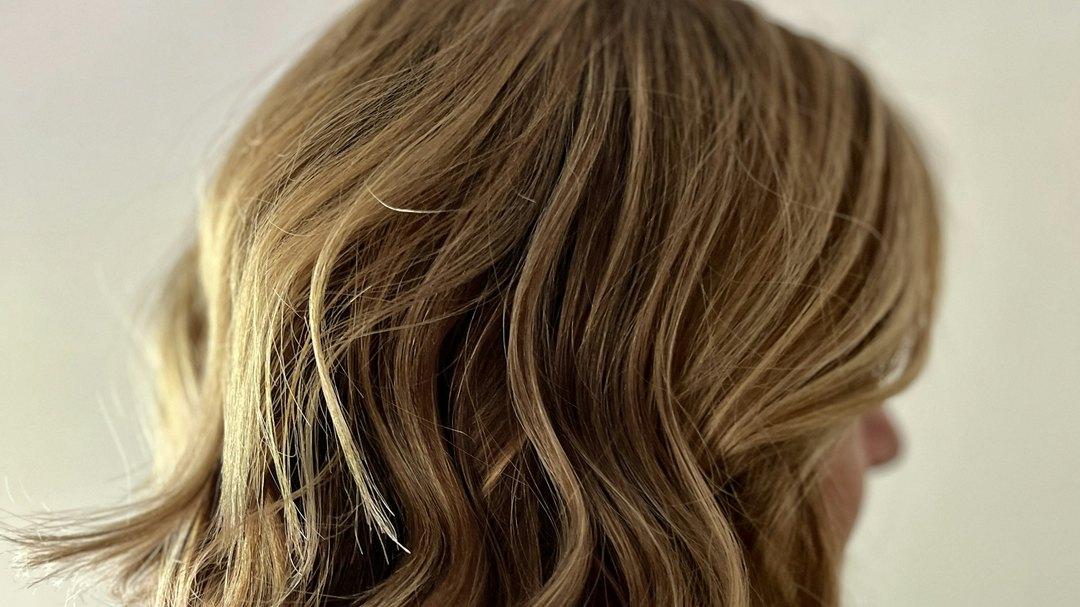
If your color looked its best the week you left the salon, the drain took most of what changed since. Dye fades mainly by dissolving in water, so every wash carries some of it away. A shampoo for color-treated hair slows that by cleaning more gently, and how often you wash decides how many times it happens.
What makes a shampoo gentler on color
Most shampoos are a blend of several cleansers, and they don't all work at the same strength. Shampoos for dyed hair use milder ones on purpose, to take less oil off with each wash.
You can see which kind you have on the back of the bottle. The lauryl sulfates, such as sodium lauryl sulfate and ammonium lauryl sulfate, are excellent cleansers and hard on hair, so they lead in shampoos for oily scalps and in clarifying shampoos. The laureth sulfates, such as sodium laureth sulfate, clean more mildly. Betaines like cocamidopropyl betaine are milder again, and they turn up in formulas for chemically treated hair because they foam moderately and leave hair easy to manage. For colored hair, look for a laureth sulfate or a betaine in the first few lines, and no lauryl sulfate.
Acidity matters too, though you can't read it off the label. Most cleansers are alkaline, and alkaline washing swells the strand and opens its outer layer. Hair in that state lets dye leak out more easily during a wash. Adding an acid to the shampoo prevents the swelling, and that step matters most for dyed hair. When a bottle says pH-balanced, this is what it's claiming, and you're taking its word for it.
Conditioning ingredients help more on colored hair than on untreated hair, because dyed and bleached hair holds onto them more readily. Dimethicone or a hydrolyzed protein a few lines down is a good sign.
What on the label is marketing
Sulfate-free tells you which cleanser was left out and nothing about what replaced it. It also lumps the harsh lauryl sulfates in with the milder laureth ones. A sulfate-free shampoo can be built on a sulfosuccinate, which is a strong cleanser in its own right, while a laureth formula with a betaine is on the gentle side and still counts as a sulfate shampoo.
Color-safe and color-lock are the brand's own descriptions of its product. The ingredient list is where you check them.
A towel check for fading
A white towel shows whether your routine is costing you color. After a normal wash, blot your hair with a white towel or an old white T-shirt and look at it by a window. A tinted patch means dye is still coming out at a rate you can see. Red shows it most, because red dye dissolves in water more readily than other shades.
If the towel picks up color, change one thing at a time and check again after three more washes. Drop one wash a week first. If the towel still comes away tinted, look at the shampoo, and swap it out if a lauryl sulfate sits near the top. Once the towel comes away clean, keep the routine as it is.
The check works best on red and darker shades. Pale blonde usually leaves too little on fabric to read, so judge it by the hair itself, in the same window light, every couple of weeks.
How often to wash colored hair
Demi-permanent color, the kind often used for glosses, fades after roughly 10 to 15 shampoos, sometimes fewer. From the same appointment, that's about two weeks if you wash every day and three to five weeks at three washes a week. Permanent color lasts much longer and follows the same arithmetic.
You may not be able to stretch your washes, and that's fine. If your scalp gets oily fast, wash on the schedule it needs and change what touches the lengths instead. Put shampoo on the scalp only and let the rinse water run down the rest.
Save clarifying shampoo for when you need it. It's built on the strong lauryl sulfates, and heavily highlighted hair is the most sensitive to it, so on that hair use it rarely or skip it. The other things that fade color between salon visits, from tap water to sun, are in making color last.
Questions people ask
Do you need a special shampoo for colored hair?
You need a mild one, and it doesn't have to say color on the front. A shampoo that leads with a laureth sulfate or a betaine, has no lauryl sulfate and lists a conditioning ingredient further down does the job, whatever it's sold as.
Should shampoo and conditioner for colored hair be from the same line?
You don't need to match them. Pick the shampoo by its cleansers and the conditioner by how your lengths feel. Use conditioner either way, since dyed hair takes it up more readily than untreated hair.
Sources
- Zhou Y, Foltis L, Moore DJ, Rigoletto R. Protection of oxidative hair color fading from shampoo washing by hydrophobically modified cationic polymers. Journal of Cosmetic Science, 2009.
- Draelos ZD. Essentials of hair care often neglected: hair cleansing. International Journal of Trichology, 2010.
- Gavazzoni Dias MFR. Hair cosmetics: an overview. International Journal of Trichology, 2015.
- American Academy of Dermatology. Tips for healthy hair.